










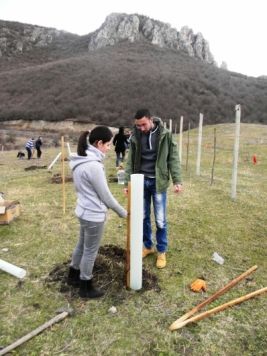
There are many examples of how our societies are collectively becoming increasingly disconnected from nature. As we progressively lose our connection to the nature, the chances that we should care, and therefore that we act to conserve and protect it, also decrease. It is not new that the amounts of time young people spend in the outdoors decreases significantly. This human cost of alienation affects youth today, but also tomorrow when shaping them into adults and afterwards when forming families and communities. Most of our actions as adults are predefined by what we have learnt throughout our life and are in a certain way done unconsciously and automatically.
It is said that the world stays on the shoulder of young people. With the state of art technology, young people these days have sufficient sources to be informed, learn and act collectively to address some of the world’s most pressing environmental problems and understand the importance of connection to the nature.
One of the most known programmes set up for young people by the European Union, is the Youth in Action. It aims to inspire a sense of active European citizenship, solidarity and tolerance among young Europeans and to involve them in shaping the Union’s future.
EUROPARC also took part in the “YiA” initiative as part of the project Action for Youth in Parks, ran in 2011 -2012. The project, co-financed by the Youth in Action programme of the EU, sought to improve quality standards in the delivery of youth environmental education across Europe and, through a better coordination of European Rangers, to enhance opportunities for young people to participate in Junior Ranger activities and new youth environmental education programmes in protected areas. The outcomes of the project are implemented into the daily work of Rangers with Junior Rangers and through the EUROPARC Junior Ranger Programme.
Youth Benefits from Nature and Forest Experiences
An interesting research shows that the environmental factors have largely been overlooked in understanding human development. Despite increasing interest in the role of context in understanding youth psychology, environment is usually regarded as the built settings where life unfolds, such as school and home. Read More
Celebrating the International Youth Day on August 12
International Youth Day (IYD) was established by the United Nations in 2000 as a means of raising awareness of issues affecting young people around the world.
Looking for a project to get involved?
* Youth and Environment Europe (YEE) is a platform of many European youth organisations that study nature or are active in environmental protection. These member organisations come together from 26 countries. The aim of YEE is to encourage youth to be involved in environmental protection and to provide a platform where these organisations can work together.
More Information
* WCPA Young Professionals Group
The Young Professionals (YP) Group of The World Commission on Protected Areas (WCPA) is a voluntary group and a collective forum of like-minded youth and young professionals associated with protected areas and conservation in diverse capacities.
* CEESP Youth Network: An agenda for action
The CEESP Youth Network envisions an intergenerational community of leaders who learn and work together within and through IUCN, for a just, sustainable and peaceful world.
* World Programme of Action for Youth
The World Programme of Action for Youth (WPAY) is a blueprint for national action and international support to foster conditions and mechanisms to promote improved wellbeing and livelihood among young people. The WPAY covers fifteen priority areas: education, employment, poverty and hunger, the environment, drug abuse, juvenile delinquency, leisure-time activities, health, girls and young women, HIV/AIDS, information and communications technology, inter-generational issues, armed conflict, the mixed impact of globalization, and the full and effective participation of youth in society and in decision-making.
* Young Friends of the Earth Norway
Nature and Youth is the only environmentalist youth organisation in Norway. Our 80 local groups work on environmental issues all over the country. Nature and Youth seeks to be at the leading edge of the issues, speaking out on what needs to be done. We put environmental problems on the agenda, put pressure on politicians and bureaucrats, and point out environment-friendly solutions.
* Friends’ Association of Tusheti Protected Areas, established in 2009, familiarizes local youth with Tusheti Protected Areas and supports their involvement in its management. Tusheti PA, covering 113 642 he, is situated in high mountains, on the eastern part of the southern slope of the Great Caucasus. Having spectacular landscapes, beautiful nature, rich biodiversity, unique traditions and cultural-historical monuments it is one of the most stunning areas in Georgia and attracts many tourists. To preserve and promote this area, FA conducts a Junior Rangers Program. This program started in 2010. Students were selected and attended 10 days at eco-camp in Tusheti PA. There they learned about nature conservation and protected areas.
* European Youth Foundation (EYF )
* Northumberland National Park Young Volunteers
Get inspired- see what youth can do !
Intergenerational Inspiration: Youth in Action on Climate ChangeYouth together with the UN are showing how the distant world of international diplomacy and organisations can be linked to actions at the local level. Read More A youth policy resource page on environmental policy and sustainability, curated by UKYCC and AYICC from the International Youth Climate Movement. Read More CEESP Youth Engagement and Intergenerational Partnership Eco-club “Khornabuji” – In 2009, the newly establish Friends’ Association of Vashlovani PAs set up an eco-club “Khornabuji” for local youth, including children from different schools of the region. Via eco-club Friends’ Association aims to raise awareness of young generation on nature conservation and protected areas. School children and student have been involved in different projects conducted by Friends’ Association.North York Moors National Park – As part of thier strategy to develop a ‘cradle to grave’ approach to volunteering they have developed two unique ways to engage with young children and their families. In 2008 the National Park’s ‘Hedgehog Club’ was launched. The ‘Hedgehog Club’ was created as a way to work with pre-school children and their parents to help them develop an understanding and respect for the North York Moors National Park and the wildlife living within it. The second initiative, named – the ‘Explorer Club’ aims to help families explore and acquire knowledge about the different habitats within the National Park and to contribute to the conservation of these habitats through practical work tasks. Read more on the activities from the park on their website